
Best Python for Finance Courses and Books (2026): 8 Picks
The best Python for finance course for most beginners is DataCamp’s Finance Fundamentals in Python: six courses, 25 hours, no coding experience needed, updated September 2026. The best free one is Quantra’s Python for Trading: Basic, 9 hours at $0. Among books, Hilpisch’s Python for Finance goes furthest, from Python basics to derivatives, though its code targets Python 3.7.
Tradion Labs isn’t affiliated with DataCamp, QuantInsti, QuantEcon, EDHEC, 365 Data Science, HKUST, Coursera, O’Reilly, Packt or The Python Quants, and earns nothing from these links. Tradion Labs is building a quantitative learning platform with browser-based Python lessons, so once it opens it will compete with some of these courses. Every fact and price below comes from the provider’s own page, checked on November 4, 2026. Prices are in US dollars unless noted, and they vary by region and change with sales. Nobody took these courses or worked through these books for this list.
Key takeaways
- Three are free to start: Quantra’s Python for Trading: Basic ($0, 9 hours), QuantEcon’s lectures (free, Creative Commons licensed), and the first chapter of every DataCamp course.
- If you’ve never coded, pick one that says so on its page: DataCamp, Quantra and EDHEC’s Coursera specialization. 365 Data Science and Lewinson’s Cookbook ask for Python first, and Coursera rates HKUST’s course Intermediate.
- Lengths run from 6 hours (365 Data Science) to 74 hours (EDHEC’s four courses).
- Hilpisch’s Python for Finance (2nd edition, December 2018, 720 pages) has code for Python 3.7. A third edition is in early release, and O’Reilly’s catalog lists March 25, 2027 as its publication date.
- Check the Python version of anything you study. The free tutorials in this series were run on Python 3.13 and pandas 3.1 on November 4, 2026.
The best Python for finance courses and books at a glance
| Course or book | Best for | Format and length | Before you start (the provider’s words) | Price on November 4, 2026 |
|---|---|---|---|---|
| DataCamp: Finance Fundamentals in Python | A structured start if you’ve never coded | 6 courses, 25 hours | “There are no prerequisites for this track” | First chapter of each course free; Premium $28 a month billed yearly, $35 monthly |
| Quantra: Python for Trading: Basic | A free start aimed at trading | Self-paced course, 9 hours | “There are no prerequisites to this course” | $0, lifetime access |
| QuantEcon: Python Programming for Economics and Finance | Scientific Python in depth, free | Online lectures in six sections | “aimed at Python novices” | Free |
| Coursera (EDHEC): Investment Management with Python and Machine Learning | Portfolio construction and machine learning | 4 courses, 74 hours | “No prior experience required” | Coursera Plus, or a single-program subscription |
| 365 Data Science: Python for Finance | Portfolio theory in one short course | 65 lessons, 6 hours | “Basic familiarity with Python programming is required” | Free previews; Self-Study $29 a month billed yearly, $36 monthly |
| Coursera (HKUST): Python and Statistics for Financial Analysis | Statistics and regression on stock data | 4 modules, about 12 hours | Intermediate level | Coursera Plus, or a single-course subscription; financial aid available |
| Hilpisch: Python for Finance, 2nd edition (O’Reilly) | One book from Python basics to derivatives | Book, 720 pages, December 2018 | Tagged Beginner by O’Reilly | O’Reilly subscription, or print from retailers |
| Lewinson: Python for Finance Cookbook, 2nd edition (Packt) | Recipes for time series, risk and machine learning | Book, 740 pages, December 2022 | “Working knowledge of the Python programming language … is necessary” | $49.99 paperback, $35.99 eBook |
Coursera Plus costs $59 a month after a 7-day free trial, or $399 a year ($239 a year in an offer that ends November 30, 2026), per Coursera’s plans page. The same page lists single courses and programs at $49 to $79 a month.
How we evaluated
Each pick was judged for one reader: someone who wants to use Python for finance work (analysis, risk, valuation or trading research), whether or not they can code yet. Five things decided the order and the “best for” lines:
- What you need before you start, in the provider’s own words.
- Practice you do yourself: exercises, assignments or notebooks, not only video.
- Finance coverage: returns and risk, portfolios, valuation, derivatives, trading.
- How current it is: the last update or publication date, and the Python version where one is stated.
- Price for a US reader on November 4, 2026.
The six courses come first, from the fewest prerequisites to the most, then the two books. Every fact comes from the provider’s own page, linked in each entry. Ratings and learner counts are left out of the comparison because each site counts them differently. Nobody took these courses, bought the books or checked the certificates for this list, so it isn’t a test of teaching quality or support. The one hands-on check is four pandas lines from Hilpisch’s public code, run on made-up data and described in his entry.
Udemy and Corporate Finance Institute courses were left out; their pages refused automated fetching on November 4, 2026, so their facts couldn’t be checked the same way.
The page captures were taken signed out on November 4, 2026. Cookie banners, chat panels, sale banners and a delivery-location box were hidden; nothing else was changed.
1. DataCamp: Finance Fundamentals in Python
Best for: a structured start if you’ve never written code.
DataCamp’s Finance Fundamentals in Python track bundles six courses. It starts with Introduction to Python for Finance, Intermediate Python for Finance and Introduction to Financial Concepts in Python. Then come time series, importing financial data and, last, Introduction to Portfolio Analysis in Python.
DataCamp lists it at 25 hours, says “There are no prerequisites for this track” and “no prior coding experience needed”, and shows “Updated 09/2026”. The libraries it names are pandas, NumPy, statsmodels and pyfolio, and finishing the track earns a Statement of Accomplishment.
The free Basic plan opens the first chapter of every course. The rest needs Premium, at $28 a month billed yearly or $35 month to month (DataCamp pricing).
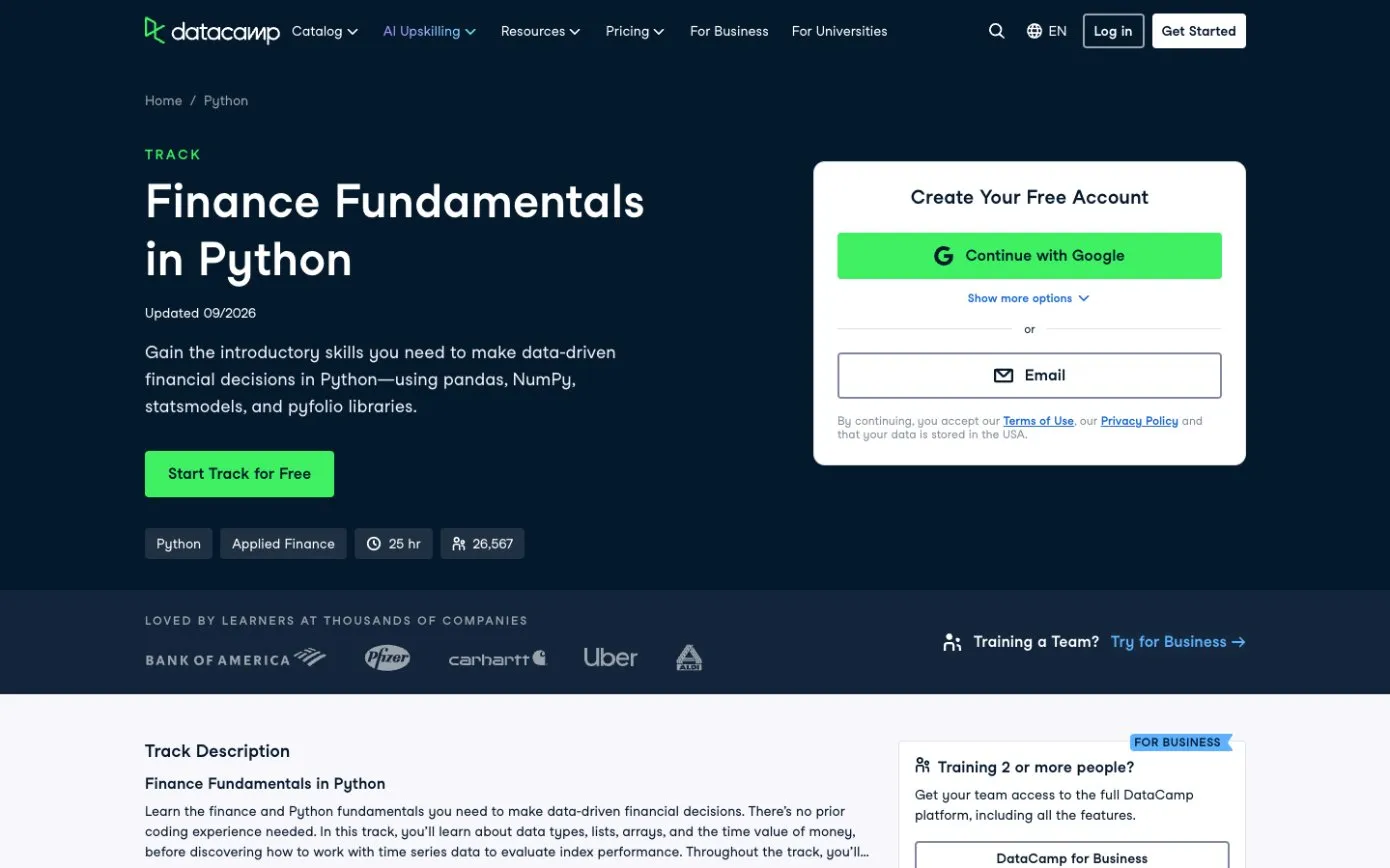 DataCamp’s track page, captured November 4, 2026.
Pros: no prerequisites, updated two months before this check, and it runs from Python basics to the time value of money, time series and portfolio analysis. Cons: past the first chapters it’s a subscription, and at 25 hours it’s the second-longest of the courses that list hours, after EDHEC’s.
Skip it if: you already use pandas. Start with 365 Data Science or Lewinson’s Cookbook instead.
2. Quantra: Python for Trading: Basic
Best for: a free start aimed at trading rather than corporate finance.
QuantInsti’s Python for Trading: Basic is listed at 9 hours, Beginner level, $0 with lifetime access (the page shows $49 struck through), and says “There are no prerequisites to this course”.
It covers Python basics (data structures, loops, functions and object-oriented code), fetching stock prices, and pandas, NumPy and Matplotlib, then a buy-and-hold strategy, paper trading and live trading on Blueshift. The page says you can paper trade “without any installations or downloads”. Its skills list adds three finance basics: interest rate calculation, compounding and the time value of money.
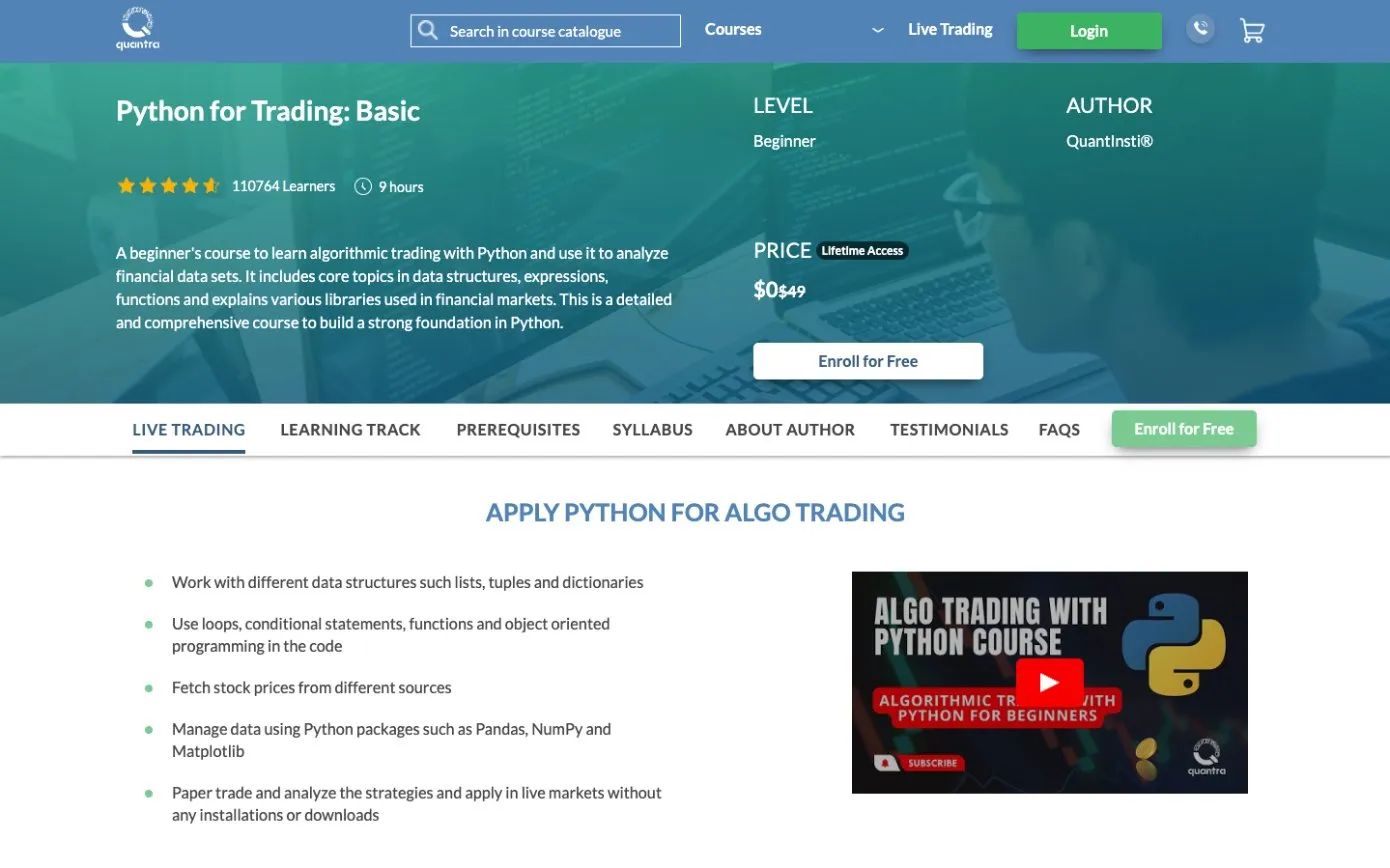 Quantra’s course page, captured November 4, 2026.
Pros: free, short, no prerequisites, and it ends with a strategy you run rather than only exercises. Cons: past interest, compounding and the time value of money, it’s about trading mechanics, with no valuation or portfolio math on its page. The site was also advertising paid courses with a sale banner on the day of this check.
Skip it if: you want finance theory or corporate finance rather than trading.
3. QuantEcon: Python Programming for Economics and Finance
Best for: learning scientific Python properly, for free.
Python Programming for Economics and Finance is the first of QuantEcon’s lecture series, by Thomas J. Sargent and John Stachurski. Its about page says the series “is aimed at Python novices, although experienced users will also find useful content in later lectures”.
The six sections are Introduction to Python, Foundations of Scientific Computing (NumPy, Matplotlib, SciPy), High Performance Computing (Numba, JAX), Working with Data (pandas and Polars), More Python Programming, and Other. The lectures are licensed under Creative Commons Attribution-ShareAlike 4.0.
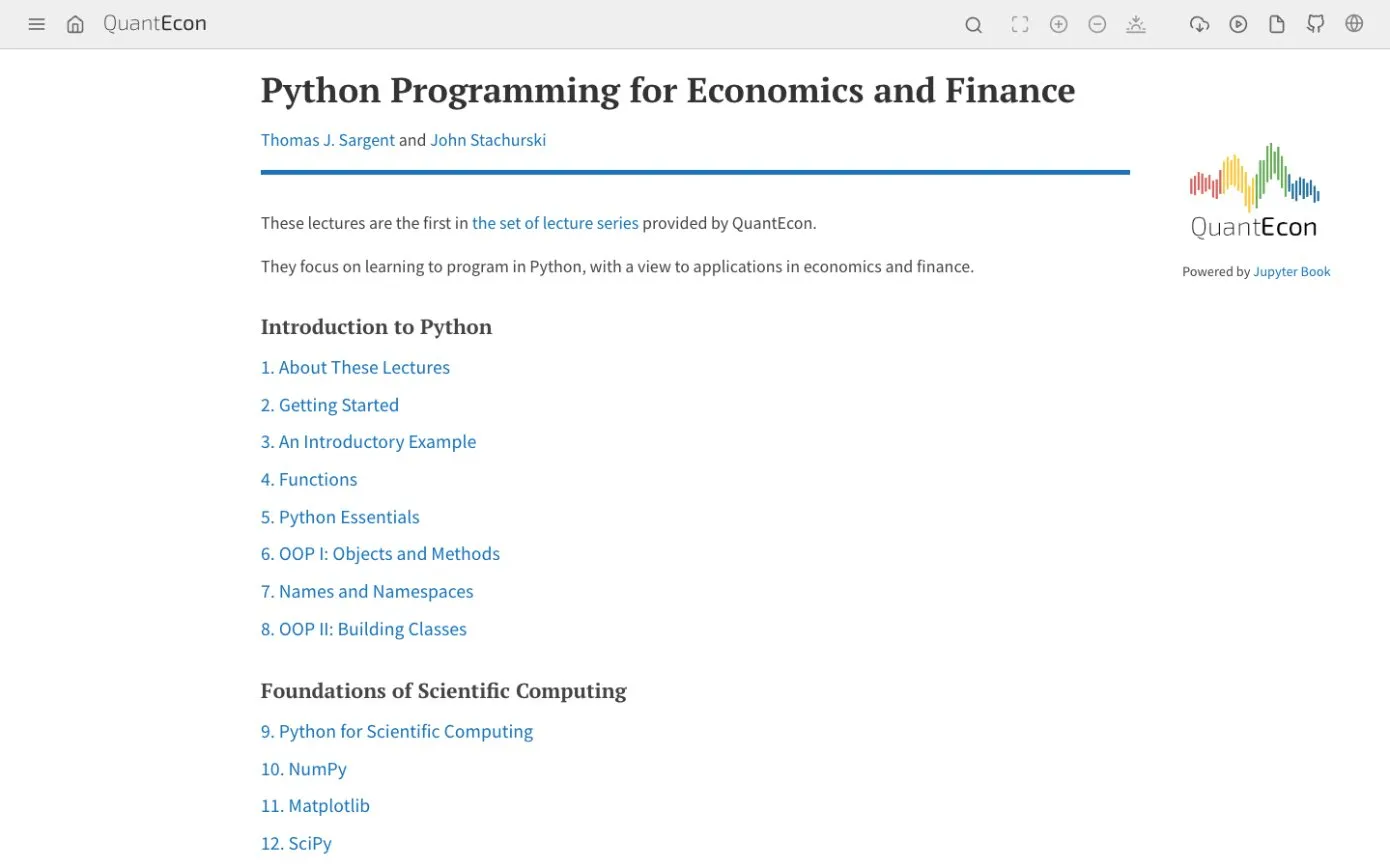 QuantEcon’s lecture page, captured November 4, 2026.
Pros: free and openly licensed, and the only pick here that teaches Numba and JAX for fast numerical code. Cons: none of its sections is about finance itself, so returns, risk and valuation come from somewhere else.
Skip it if: you need finance topics now. Pair it later with a finance course, or with the Python for finance guide on this blog.
4. Coursera (EDHEC): Investment Management with Python and Machine Learning
Best for: a long, structured path into portfolio construction and machine learning.
EDHEC Business School’s specialization has four courses:
- Introduction to Portfolio Construction and Analysis with Python (25 hours)
- Advanced Portfolio Construction and Analysis with Python (12 hours)
- Python and Machine Learning for Asset Management (16 hours)
- Python and Machine-Learning for Asset Management with Alternative Data Sets (21 hours)
That’s 74 hours. The top of the page puts it at “2 months to complete at 10 hours a week”, while its FAQ says “Approximately 4 months to complete”. The page says Beginner level and “No prior experience required”, and the FAQ adds that no prior knowledge of Python or portfolio analysis is assumed. It lists six instructors and ends with a career certificate from EDHEC.
It’s included with Coursera Plus ($59 a month after a 7-day trial, or $399 a year, $239 until November 30, 2026). The page’s button reads “Enroll for free”, but its FAQ answers “Can I take the course for free?” with “No, you cannot take this course for free.” Financial aid is available, and Coursera’s plans page lists single programs at $49 to $79 a month.
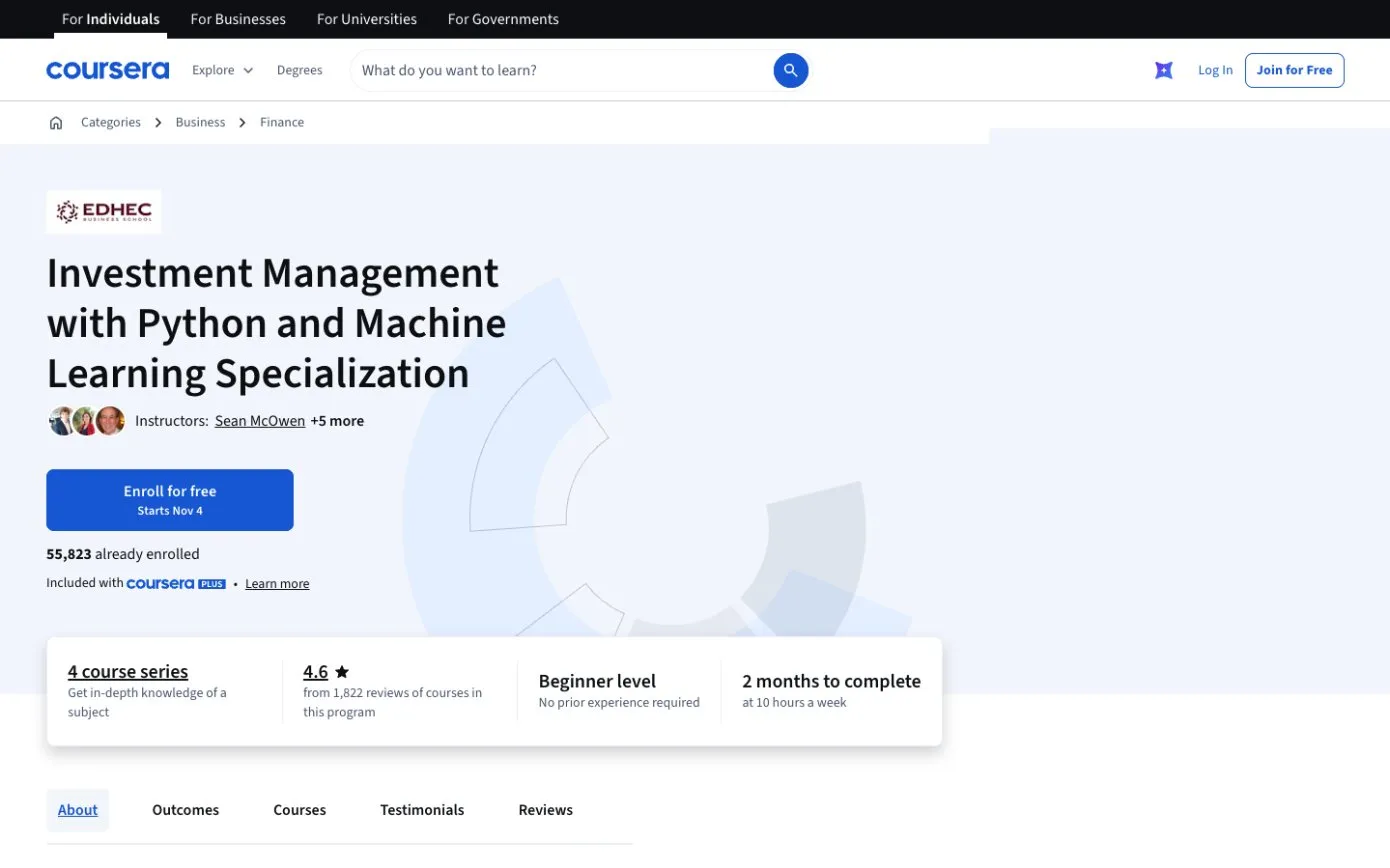 Coursera’s specialization page, captured November 4, 2026.
Pros: the most finance depth of any course here, from a business school, with a certificate. Cons: 74 hours is a big commitment, and all four course titles are about portfolios and asset management, not trading or company valuation.
Skip it if: you want a quick start or you don’t plan to work on portfolios.
5. 365 Data Science: Python for Finance
Best for: portfolio theory in one short course, once you know basic Python.
Python for Finance, taught by Martin Ganchev and Ned Krastev, is listed at 6 hours, with 65 lessons, 27 exercises, 4 exams, 7.5 CPE credits and what the page calls an “Accredited certificate”. It covers rates of return and risk, portfolio risk (idiosyncratic and market), Markowitz optimization and the efficient frontier, CAPM, Monte Carlo simulation and regression. The prerequisites are Python 3.8 or later, pandas and a code editor: “Basic familiarity with Python programming is required. Familiarity with NumPy is helpful but not mandatory.”
The free plan includes course previews. Self-Study costs $29 a month billed yearly or $36 monthly (365 Data Science pricing).
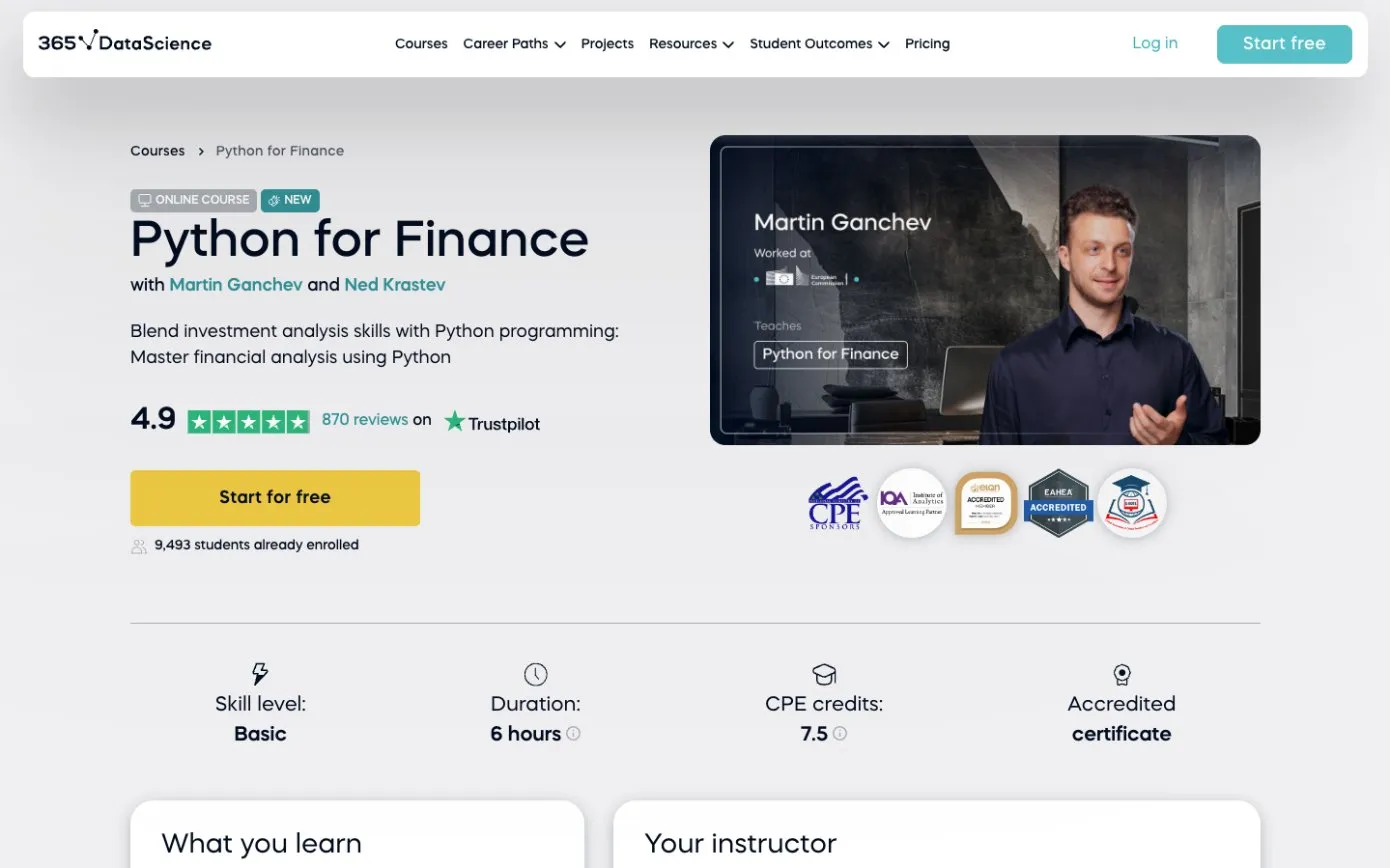 365 Data Science’s course page, captured November 4, 2026.
Pros: short, and it reaches Markowitz, CAPM and Monte Carlo in six hours, with CPE credits for accountants who need them. Cons: you install Python and an editor yourself, and six hours means each topic gets an introduction rather than depth.
Skip it if: you’ve never coded. Start with DataCamp or Quantra and come back.
6. Coursera (HKUST): Python and Statistics for Financial Analysis
Best for: the statistics behind financial analysis, run on stock data.
Python and Statistics for Financial Analysis is from The Hong Kong University of Science and Technology and taught by Xuhu Wan. Its four modules are Visualizing and Munging Stock Data (3 hours), Random variables and distribution (2 hours), Sampling and Inference (3 hours) and Linear Regression Models for Financial Analysis (4 hours). Coursera lists it as Intermediate level, “1 week at 10 hours a week”, with 7 assignments and a shareable certificate. The page says a Jupyter Notebook environment is set up on the course platform, so you don’t install anything, and that financial aid is available.
It’s included with Coursera Plus, at the prices above.
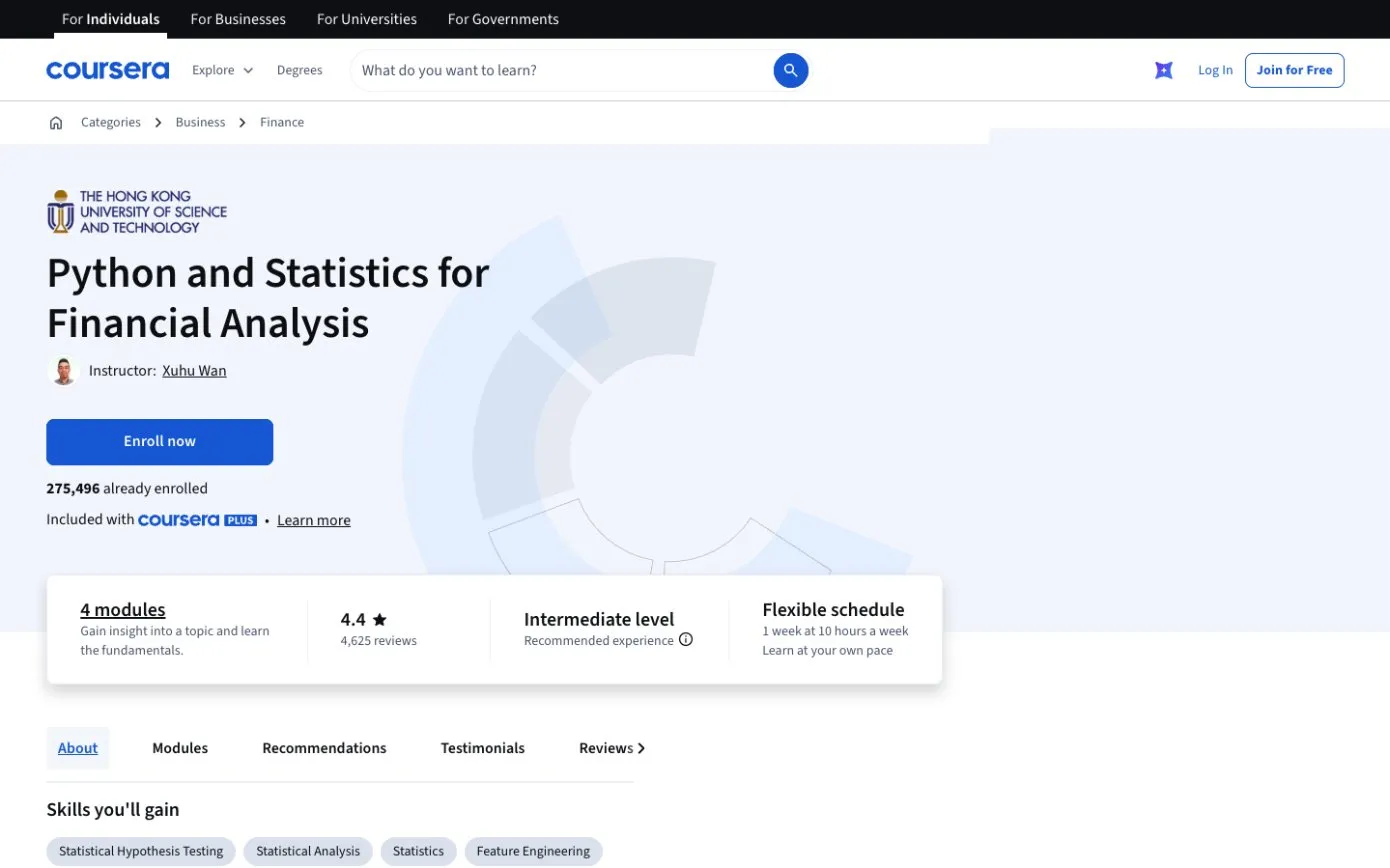 Coursera’s course page, captured November 4, 2026.
Pros: statistics and regression taught on market data, with nothing to install and financial aid. Cons: about 12 hours of module time, no portfolios or valuation in its module list, and trading comes up only in module 1’s simple trend-following strategy and module 4’s regression-based trading model.
Skip it if: you want a general introduction. This one fits best after a beginner course, before work like the rolling beta and drawdown tutorial.
7. Yves Hilpisch: Python for Finance, 2nd edition (O’Reilly)
Best for: one book that goes from Python basics to derivatives pricing.
Python for Finance: Mastering Data-Driven Finance was published by O’Reilly in December 2018 and runs 720 pages; O’Reilly tags it Beginner. Its 21 chapters sit in five parts: Python and Finance, Mastering the Basics (data types, NumPy, pandas, object-oriented code), Financial Data Science (visualization, financial time series, stochastics, statistics), Algorithmic Trading, and Derivatives Analytics. The last part builds what O’Reilly’s overview calls “a full-fledged framework for Monte Carlo simulation-based derivatives and risk analytics”.
The code is free on GitHub in py4fi2nd, whose README says “The codes of the book are based on Python 3.7.” The same README says the repository’s code was tested on Python 3.6, because TensorFlow didn’t yet work with 3.7 when it was made.
To see what that means today, four pandas lines from the repository’s chapter 5 (pandas) and chapter 8 (financial time series) notebooks were run on November 4, 2026 with Python 3.13.8 and pandas 3.1.0, on made-up data. Two failed: the monthly frequencies in pd.date_range(..., freq='M') and resample('1m') now raise a ValueError, and pandas asks for 'ME' instead. resample('1w') still runs with a deprecation warning that asks for 'W', and resample(rule='5min') runs unchanged. Changing 'M' to 'ME' and '1m' to '1ME' fixed both failures.
A third edition is in early release on O’Reilly: 750 pages, with March 25, 2027 as the listed publication date, and its companion code is in py4fi3rd. Hilpisch’s company, The Python Quants, also sells a Certificate in Python for Finance at €2,999 for the bundle (VAT depending on your tax status), taken in 16-week guided cohorts or self-paced.
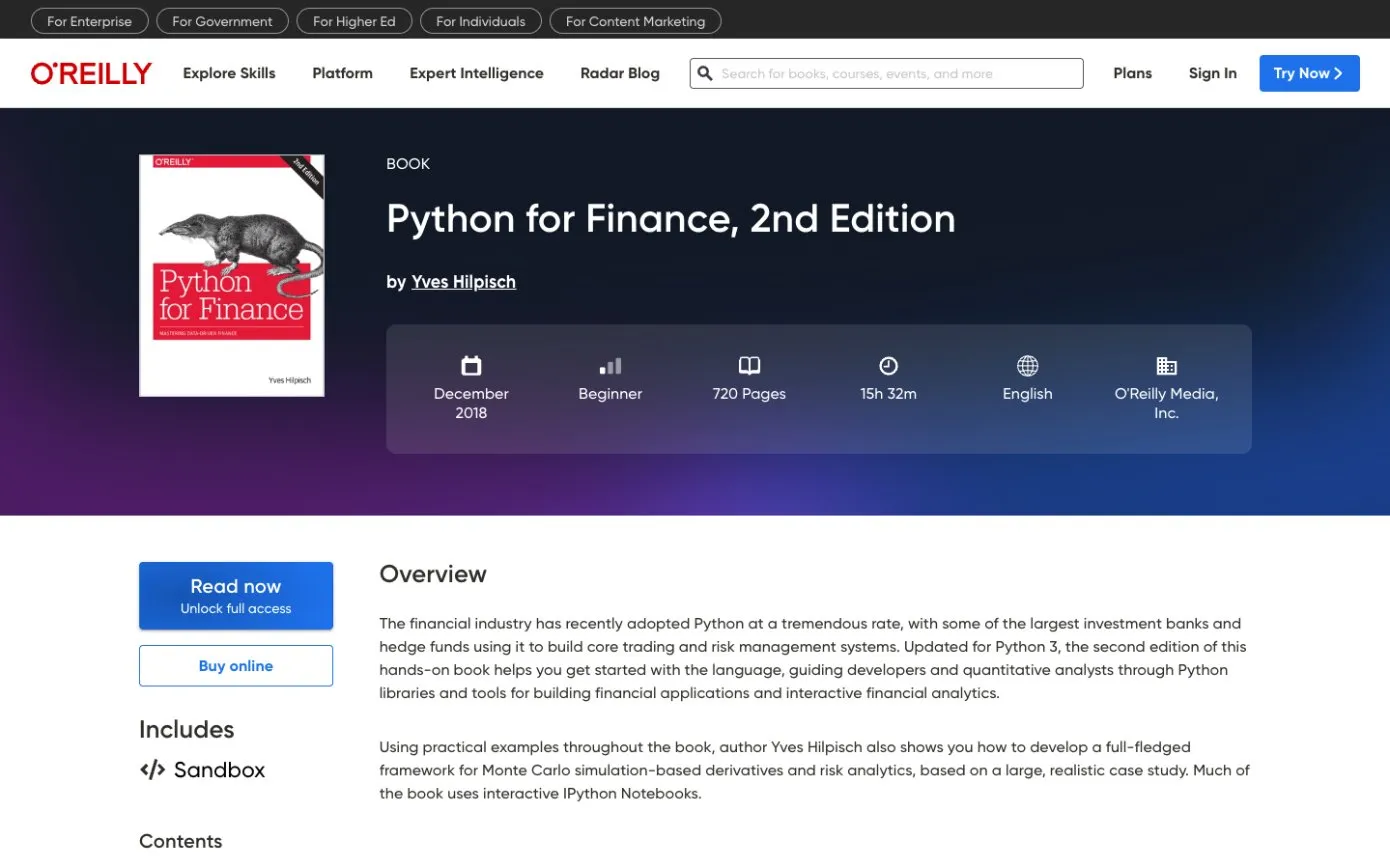 O’Reilly’s book page, captured November 4, 2026.
Pros: the widest coverage of anything here, from NumPy to option valuation, with all code public. Cons: the code targets Python 3.7 and the pandas of 2018, and the trading part opens with a chapter on the FXCM trading platform.
Skip it if: you want code that matches today’s libraries. Wait for the third edition, or use the Cookbook.
8. Eryk Lewinson: Python for Finance Cookbook, 2nd edition (Packt)
Best for: ready-made recipes for time series, volatility, risk and machine learning, once you know pandas.
The Python for Finance Cookbook (2nd edition, Packt, December 30, 2022, 740 pages) promises “over 80 powerful recipes”. Packt says it’s for “financial analysts, data analysts and scientists, and Python developers with a familiarity with financial concepts”. It adds that “Working knowledge of the Python programming language (particularly libraries such as pandas and NumPy) is necessary.” The recipes cover technical indicators and backtesting, time series models (exponential smoothing, ARIMA, Prophet), Monte Carlo for derivatives and risk, and GARCH volatility models. Later ones cover asset allocation, a default-prediction machine learning project, and deep learning models such as TabNet and DeepAR.
On Packt’s US page the paperback costs $49.99 and the eBook $35.99 (listed at $39.99). The code is on GitHub.
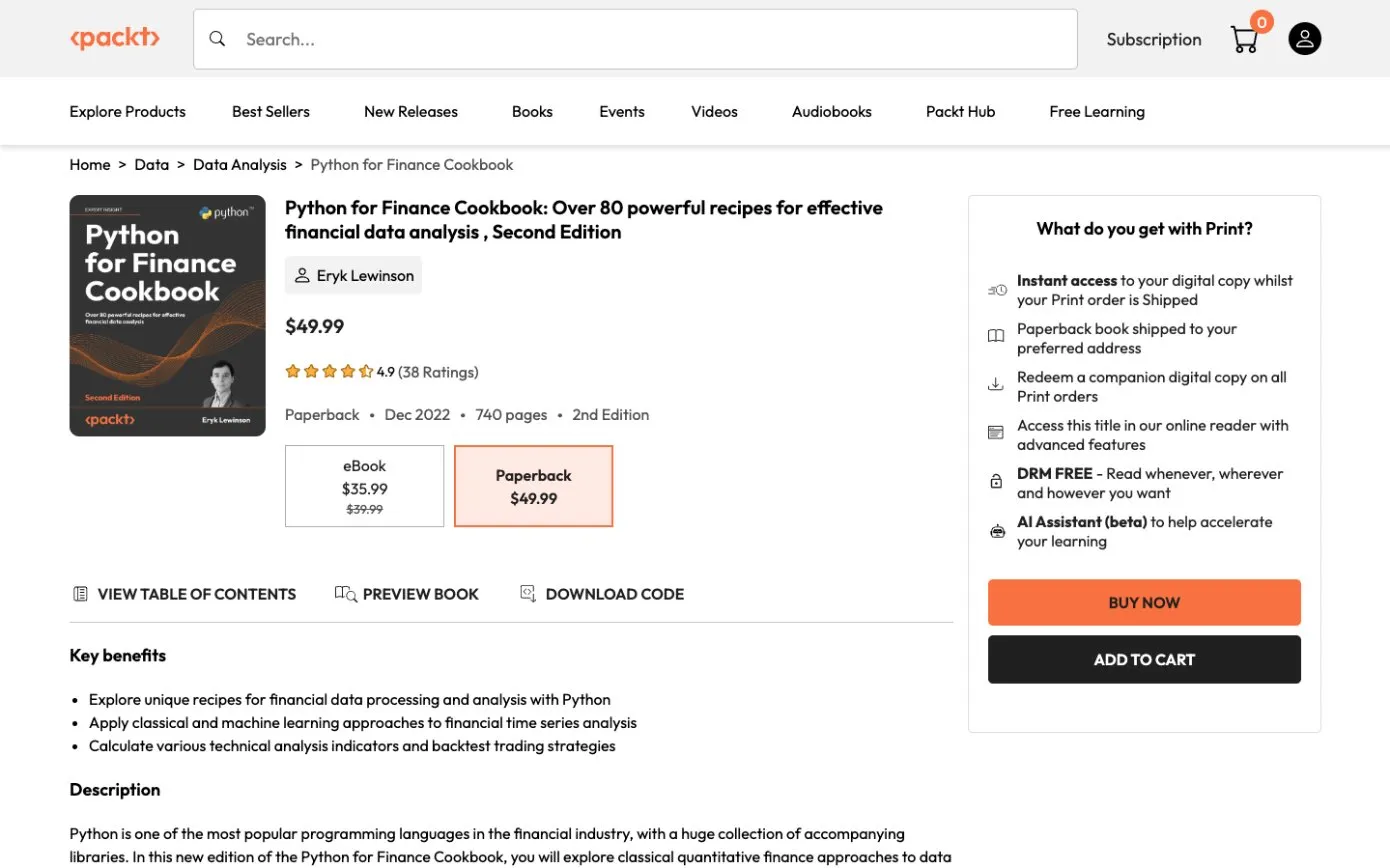 Packt’s book page, captured November 4, 2026.
Pros: four years newer than Hilpisch’s second edition, with recipes for GARCH, Prophet and deep learning models that none of the courses here list. Cons: it assumes pandas and finance basics, and recipes don’t teach in order the way a course does.
Skip it if: you’re new to Python. Come back after a beginner course.
How to choose a Python for finance course
Can you code yet?
If not, choose a course whose page says so: DataCamp (“no prior coding experience needed”), Quantra (“no prerequisites”) or EDHEC (“No prior experience required”). 365 Data Science, HKUST and the Cookbook assume Python. Learning the language with QuantEcon first and finance second also works, and costs nothing.
Trading, investing or corporate finance?
Quantra and the trading part of Hilpisch’s book are about strategies and orders. EDHEC and 365 Data Science are about portfolios. For company valuation, try the free DCF from SEC filings tutorial in this series.
Course, lectures or book?
A course sets the order and checks your work with exercises or assignments. QuantEcon’s lectures are free text with code you run yourself. Books go deepest, but nobody checks your work.
Check the Python version
Python and pandas change: pandas 3 came out after both books’ editions. Hilpisch’s second-edition code is for Python 3.7, and in the spot check above, two of four pandas lines from it needed a one-word fix. The tutorials in this series state the versions they ran on, Python 3.13.8 and pandas 3.1.0, so you can match them.
Try the free parts first
Before paying, try DataCamp’s first chapters, 365 Data Science’s previews, Coursera Plus’s 7-day trial, or Quantra and QuantEcon in full. Or start with this blog’s free tutorials: npv, irr and pmt with numpy-financial, an option and a bond in QuantLib and VaR and Monte Carlo in Python.
FAQ
Is Python for Finance by Yves Hilpisch still worth reading?
For breadth, yes: its second edition runs from Python basics to derivatives valuation in 720 pages, and all its code is on GitHub. The code is for Python 3.7, from December 2018, so some of it needs changes on today’s libraries: in a November 4, 2026 spot check on pandas 3.1.0, two of four pandas lines failed until 'M' became 'ME'. A third edition is in early release, with a listed publication date of March 25, 2027.
Can I learn Python for finance for free?
Yes. Quantra’s Python for Trading: Basic costs $0, QuantEcon’s lectures are free and openly licensed, and DataCamp’s free plan opens the first chapter of every course. Both Coursera pages say financial aid is available, though EDHEC’s FAQ says its specialization can’t be taken for free.
How long does it take to learn Python for finance?
The courses here list 6 hours (365 Data Science), 9 hours (Quantra), about 12 hours (HKUST), 25 hours (DataCamp) and 74 hours (EDHEC). Those are their own estimates for the material, not for being job-ready. Calendar time varies even on one page: EDHEC’s says “2 months to complete at 10 hours a week” at the top and “Approximately 4 months” in its FAQ.
Is there a Python for finance certification?
Several give a certificate: EDHEC’s career certificate and HKUST’s shareable certificate on Coursera, DataCamp’s Statement of Accomplishment, and 365 Data Science’s certificate with 7.5 CPE credits. The Python Quants’ Certificate in Python for Finance costs €2,999 for the bundle.
Which Python libraries do finance courses teach?
pandas and NumPy come up most: DataCamp, Quantra, QuantEcon, 365 Data Science and the Cookbook name both, and HKUST lists pandas. DataCamp adds statsmodels and pyfolio, QuantEcon adds SciPy, Numba, JAX and Polars, and the Cookbook adds Prophet and GARCH models.
Which should you choose?
Start with DataCamp’s track if you’ve never coded and want structure, or Quantra’s free course if you want to trade. Take 365 Data Science for a short portfolio course once you know basic Python, EDHEC for two months of asset management, and HKUST for statistics. Use QuantEcon to learn scientific Python properly at no cost.
For a book, Hilpisch’s Python for Finance covers the most ground, but its code is for Python 3.7; Lewinson’s Cookbook is newer and assumes pandas. Whichever you pick, the free tutorials in this series show each topic run end to end with real data and the versions stated.